Threadripper vs. Ryzen for Professional Workstations: Which Platform Makes Sense?

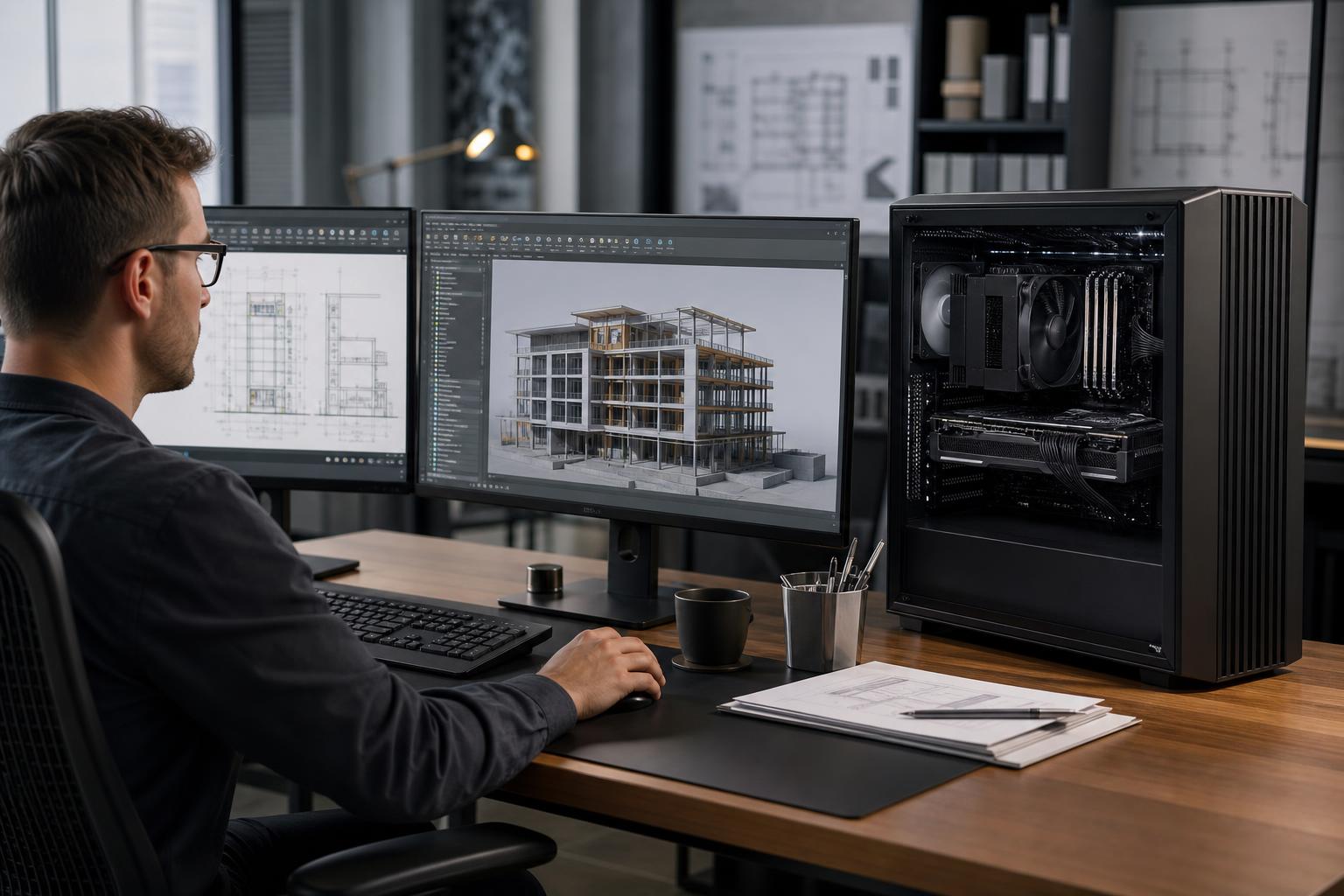
A workstation CPU choice is not simply a question of buying the processor with the most cores. For many professional users, a mainstream Ryzen system is faster where it counts, costs less, and is easier to configure. For others, Threadripper is the platform that prevents a workstation from running out of memory, storage expansion, GPU capacity, or CPU throughput halfway through its useful life.
The right answer comes down to how your software uses hardware. A CAD technician working mainly in responsive, lightly threaded models has different needs than a visualization artist rendering all day, a survey team processing large point clouds, or an engineer running simulations while several applications remain open.
This guide explains where each platform makes sense, where spending more has a real business benefit, and where it does not.
Modern Ryzen desktop processors are built for high clock speeds and strong per-core performance. They are excellent for applications that rely heavily on one or a few fast CPU cores. That includes much of day-to-day CAD work: drawing, modeling, navigating models, rebuilding features, and general office multitasking.
Threadripper is AMD’s workstation-class platform. Its main advantages are not just higher core counts. It also offers substantially more memory capacity, more memory bandwidth, and far more PCIe connectivity for graphics cards, NVMe storage, capture cards, high-speed networking, and other expansion hardware.
That distinction matters. A high-core-count processor installed on a restricted desktop platform is still limited by the platform’s memory and expansion. Threadripper exists for workloads where those limits become a real problem.
A Ryzen workstation is usually the better value for professionals whose primary applications are lightly threaded or only moderately parallelized. A well-configured Ryzen system can feel extremely responsive in AutoCAD, Revit modeling, Civil 3D design work, SketchUp, Adobe applications, software development, and many general engineering workflows.
It is also a sensible choice for an individual professional or small team that needs one capable GPU, 32GB to 96GB of memory, and several fast NVMe drives without unusual expansion requirements.
In plain English: if your biggest frustration is that models and applications feel sluggish while you are actively working, prioritize fast individual CPU cores before chasing a huge core count.
Threadripper earns its cost when work is genuinely parallel, datasets are large, or the system must support hardware that a mainstream desktop platform cannot comfortably accommodate.
Good candidates include:
A Threadripper workstation is often less about making one task feel a little faster and more about keeping the whole machine productive under a full professional workload.
CPU core count is easy to compare on a spec sheet, but it is not a universal performance score. Software has to divide work effectively across many cores before a 32-, 64-, or higher-core CPU can show its advantage.
Many CAD and BIM applications spend much of the workday on lightly threaded tasks. Model interaction, viewport responsiveness, design changes, and certain calculations may benefit more from strong per-core performance than from an enormous number of cores.
For these users, a mainstream Ryzen CPU with high clock speeds can be the practical sweet spot. Extra budget often delivers more value when directed toward adequate RAM, a suitable GPU, fast project storage, and a reliable backup plan.
Threadripper makes more sense when your software can keep many cores busy for long periods. CPU-based rendering, some simulation and analysis tools, large code builds, data processing, and batch exports are common examples. It can also be valuable when a workstation handles several demanding jobs at once.
Do not assume that a task is fully multi-threaded just because it is difficult or takes a long time. Check the documentation for your exact applications, and pay attention to where time is actually going: active design work, rendering, importing, exporting, meshing, encoding, or processing.
RAM is where many professional systems become constrained before the CPU is truly inadequate. When memory fills up, Windows begins relying more heavily on storage as virtual memory. Even with a fast NVMe SSD, that is a major performance penalty. Applications may lag, caches may be cleared, and large projects can become unstable or impossible to work with comfortably.
Mainstream Ryzen platforms use dual-channel memory and can support substantial RAM capacities. That is enough for a great many CAD, design, editing, and development systems. For practical buying decisions, 64GB is a strong starting point for serious professional work, while 96GB or 128GB is sensible for heavier projects and multitasking.
Threadripper platforms provide more memory channels and support much larger memory configurations. Standard Threadripper systems are designed for high-bandwidth, ECC registered memory, while Threadripper PRO expands memory capacity and bandwidth further for users with especially demanding datasets and platform requirements.
That matters for workloads such as large point clouds, dense photogrammetry projects, simulation, virtual machines, scientific computing, and large scene assembly. If project files, source data, caches, and multiple applications regularly push a system beyond 128GB, a Threadripper platform is usually the cleaner long-term solution.
PCIe lanes are the high-speed connections linking the CPU to GPUs, NVMe drives, networking cards, and other devices. A mainstream Ryzen desktop is well suited to one GPU and a sensible number of storage drives. That describes most professional systems.
Threadripper provides far more PCIe connectivity. This is a major benefit for systems that need multiple GPUs, several NVMe drives operating without awkward compromises, high-speed networking, RAID or storage controllers, and other add-in cards.
Threadripper PRO goes further for organizations building highly expandable systems. It is the platform to consider when the workstation is also becoming a small compute node, a large local-storage machine, or a specialized production tool with several expansion devices.
More PCIe lanes are not automatically useful. If you need one GPU, two NVMe drives, and standard networking, they will not make your CAD drawings open faster. But if you need two GPUs, 10GbE, four or more high-speed drives, and room to expand, starting with a mainstream platform can create avoidable limitations.
Best for AutoCAD, Revit modeling, Civil 3D, general design work, development, moderate video editing, and many single-GPU creative applications. Prioritize a strong Ryzen CPU, 64GB of RAM for demanding professional use, a GPU selected for the actual application, and separate NVMe storage for Windows, active projects, and cache files when the workflow benefits from it.
This is the right answer for many users. It is not a compromise simply because it is not Threadripper.
Best for heavy CPU rendering, advanced reality capture, significant point-cloud work, simulation, large project multitasking, or systems that need more RAM and expansion than a desktop platform handles comfortably. This tier should include enough memory from day one, strong sustained cooling, quality power delivery, and storage designed around project files and scratch workloads rather than a single oversized drive.
Best for very large datasets, exceptional memory requirements, multi-GPU compute, extensive PCIe expansion, and organizations that need a workstation platform with substantial room to grow. It is not the default recommendation for every technical professional. It is the right tool when the work clearly demands its memory, bandwidth, and expansion advantages.
No. CPU platform and GPU category are separate decisions. A consumer GPU can offer excellent rendering, video, AI, and GPU-compute performance when its VRAM capacity, drivers, and software compatibility fit the workload. A professional GPU may be the better choice when application-specific driver support, large VRAM capacity, display requirements, or vendor-validated workflows matter to your organization.
Match the GPU to the software first. Then choose Ryzen or Threadripper based on CPU behavior, memory needs, and expansion requirements. Pairing a Threadripper CPU with the wrong GPU does not make the system balanced.
Before selecting a workstation, list the applications your team actually uses, the size of typical and largest projects, the number of displays, required add-in cards, current storage usage, and expected growth over the next several years. Also identify which steps consume time: interactive design, rendering, exports, processing, compilation, or moving data across the network.
If your work is mainly interactive and lightly threaded, buy a fast Ryzen workstation and invest sensibly in memory, GPU capability, and storage. If memory limits, sustained multi-core processing, or expansion constraints are actively slowing work, Threadripper is often worth the additional platform cost.
Overclock Computers can help configure a custom workstation around your specific software, typical project sizes, data storage needs, expansion plans, and budget. Contact our team with your workflow details, and we will help you choose a balanced system instead of simply selling you more hardware than you need.