Best Workstation for Revit: Practical Specs for Architects and BIM Teams

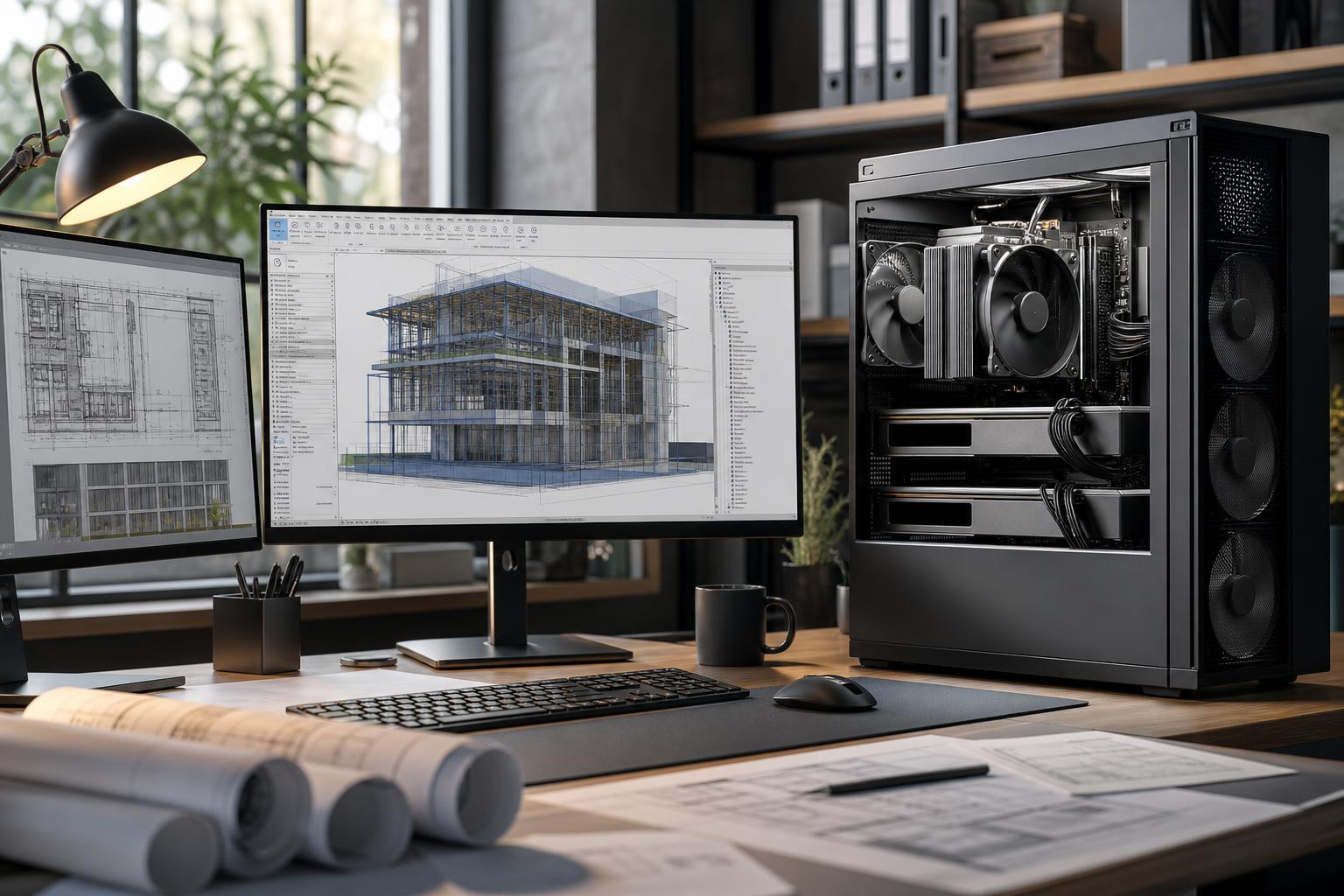
The best workstation for Revit is usually a balanced system with a fast modern CPU, 32GB to 64GB of RAM, a capable professional or gaming-class GPU with adequate VRAM, and fast NVMe storage. For most architects and BIM professionals, spending heavily on a flagship graphics card is less useful than buying a stronger CPU, enough memory, and reliable cooling.
Revit feels slow for several different reasons, and each one points to a different hardware need. Opening a large central model, switching views, regenerating geometry, running schedules, exporting sheets, using linked models, and rendering do not all lean on the same component. A workstation that looks impressive on a parts list can still be frustrating if its budget was placed in the wrong areas.
Here is the practical short answer:
The right choice depends mainly on model size, linked files, rendering tools, the number of applications open at once, and how long you need the workstation to remain useful.
Revit relies heavily on CPU performance, and much of the interactive work benefits most from strong single-core speed. That includes common tasks such as navigating and updating views, editing model elements, and much of the general interface responsiveness. A modern processor with high boost clocks and strong per-core performance makes the computer feel quicker during the work you repeat all day.
More cores are still valuable. They help with some calculations, exporting, rendering, running several applications, and keeping the system responsive while background tasks are active. But a workstation bought primarily for Revit should not sacrifice per-core speed simply to chase the largest core count available.
Recommendation: An 8- to 12-core mainstream desktop CPU is an excellent starting point for many Revit users. Move to 12 to 16 high-performance cores when you regularly work with complex projects, run rendering software, compile large exports, or keep Revit, AutoCAD, Rhino, Adobe applications, and browser-based project tools open together. Very high core-count platforms make more sense when rendering, simulation, or other heavily multithreaded work is a major part of the job—not just an occasional task.
Memory capacity has a direct effect on how comfortably you can work with large Revit files, linked models, point clouds, multiple views, and supporting applications. When RAM runs short, Windows shifts data to storage. Even a fast SSD is far slower than memory, and the result is sluggish switching, delays, and an unpleasantly busy system.
32GB is reasonable for smaller to moderate projects and a focused workflow. It is no longer the comfortable long-term choice for many professional BIM users. 64GB is the practical recommendation for architects, designers, and coordinators who routinely handle larger models or multitask. 128GB is worth considering for exceptionally large federated models, substantial point clouds, extensive rendering work, or users who run virtual machines and several demanding applications alongside Revit.
Do not buy 16GB in a new Revit workstation unless the work is genuinely light. It saves money at checkout and becomes a limitation quickly.
The graphics card helps with the responsive display of 3D views, visual styles, high-resolution monitors, and GPU-accelerated companion software. It becomes more important if your workflow includes real-time visualization, GPU rendering, Enscape-style visualization tools, Twinmotion, Unreal Engine, or 3D work outside Revit.
For Revit modeling alone, the most expensive GPU is rarely the best use of money. A well-chosen midrange card will often provide a better overall workstation when the saved budget goes toward more RAM, a faster CPU, or larger storage. For a single 1440p or 4K display and typical Revit projects, aim for a modern GPU with at least 8GB of VRAM. For large scenes, multiple high-resolution displays, visualization, or GPU rendering, 12GB to 16GB or more provides useful breathing room.
Professional graphics cards can be appropriate in environments that require their specific driver support, feature set, or vendor validation. However, they are not automatically faster for every Revit user. A good workstation should be selected around the applications your team actually uses, not the label on the GPU box.
Storage does not replace sufficient RAM, but it still matters. Large project files, linked files, local copies, textures, exports, backups, and rendering caches can consume space quickly. A cramped drive also makes workstation maintenance harder than it needs to be.
Start with a 1TB NVMe SSD for a modest workload. For most professional users, 2TB is the more sensible starting capacity. Consider separate drives when local project files, render output, point clouds, video, or large asset libraries are part of the workflow. Keeping active work on a fast SSD and maintaining a proper backup process is far more useful than filling one small drive to the edge.
Cloud sync and network storage are useful for collaboration, but they are not substitutes for a sensible local storage plan. A workstation needs enough local workspace to operate efficiently.
This is the sensible level for an individual designer working on smaller projects, basic 3D views, documentation, and occasional related CAD work. If the budget is tight, avoid cutting RAM or buying a low-quality power supply to fund cosmetic extras.
This is where we would place most full-time Revit users. It has the CPU speed for daily model work, enough RAM for demanding projects and multitasking, and a GPU that supports comfortable 3D work and visualization without turning the build into an expensive showpiece.
This tier is for complex coordinated models, large linked datasets, point clouds, frequent rendering, real-time visualization, and professionals whose workstation downtime costs real money. It is not automatically the best choice for a Revit-only drafting workstation. Its premium components need a workload that can use them.
Spend more on CPU speed, RAM capacity, storage capacity, cooling, and a quality power supply. These choices affect daily responsiveness, stability, noise, and useful service life. A workstation that maintains its performance during long exports or rendering sessions is worth more than one that looks impressive but runs hot and loud.
Save money by avoiding excessive motherboard features you will never use, oversized power supplies chosen only for a wattage number, and top-tier GPUs for basic BIM modeling. RGB lighting is harmless if you enjoy it, but it should not displace memory capacity or storage.
Also consider your monitor. A good 27-inch 1440p or 4K display with usable scaling, clear text, and adequate screen space can improve daily productivity more than a small jump in GPU performance. Two well-matched displays can be particularly useful for drawings, schedules, specifications, and project communication.
A good Revit workstation is not a generic “CAD PC” with expensive parts selected at random. The best configuration changes when someone works mainly in documentation versus large federated models, when they use real-time visualization, when they process point clouds, or when they need the same machine for video, rendering, and design applications.
Overclock Computers can help configure a workstation around your Revit project sizes, linked-model workflow, visualization tools, storage requirements, budget, monitor setup, and future upgrade plans. Bring us the applications you use and the kind of projects you handle, and we can help you spend where it will make a real difference.