Best Gaming PC for 240Hz: Specs That Deliver High FPS Where It Matters

A 240Hz monitor can make a game feel noticeably more immediate than a 144Hz display. Motion is clearer, aim tracking is easier, and fast camera movement looks less blurred. But buying a powerful graphics card alone does not guarantee 240 frames per second. For many competitive games, the CPU, memory, game settings, and overall system balance matter just as much.
The best gaming PC for 240Hz is not necessarily the most expensive machine on the market. It is a system designed around the games you play, the resolution of your monitor, and whether you want a steady 240 FPS or simply the highest frame rate possible. Here is what to prioritize before spending your budget.
“240Hz gaming” covers very different workloads. A PC that maintains 240 FPS in Valorant, Rocket League, Overwatch 2, or Rainbow Six Siege does not need the same hardware as one trying to do it in Call of Duty, Fortnite with demanding visual settings, or a modern single-player game with ray tracing enabled.
Games such as Counter-Strike 2, Valorant, League of Legends, Rocket League, and many competitive shooters are often limited by CPU performance at high frame rates. A fast gaming CPU is the priority here. A midrange or upper-midrange GPU is frequently enough at 1080p, especially when competitive settings are used.
This is good news for buyers: spending every dollar on the most expensive GPU can be a poor choice if the processor cannot feed it frames quickly enough.
Titles such as Call of Duty, Apex Legends, Fortnite, Battlefield, and newer battle royale games can be demanding on both the CPU and GPU. Reaching 240 FPS may require reduced settings, upscaling, or a lower resolution. The goal should be consistent frame times rather than a benchmark result that briefly touches 240 FPS in an empty scene.
For visually intensive single-player games, a 240Hz monitor is still nice to have, but a locked 240 FPS is not a realistic or necessary target in every title. At 1440p or 4K, it usually makes more sense to prioritize image quality and a smooth 90 to 160 FPS experience, depending on the game and hardware. A good adaptive-sync monitor will make variable frame rates feel much smoother than they did on older fixed-refresh displays.
Resolution has a huge effect on the gaming computer you need. The jump from 1080p to 1440p adds substantially more pixels for the GPU to render. Moving to 4K raises that workload dramatically again.
For most buyers researching the best gaming PC for 240Hz, we recommend 1440p. It is a strong all-around choice: clear enough for a large monitor, less punishing than 4K, and capable of excellent high-refresh performance with the right graphics card.
At 240Hz, the processor matters more than many buyers expect. The CPU handles game logic, player movement, physics, draw-call preparation, background tasks, and communication with the graphics card. When it cannot complete that work quickly enough, the GPU waits. This is a CPU bottleneck.
For a dedicated 240Hz gaming PC, choose a current upper-tier gaming CPU rather than an entry-level chip with an oversized graphics card. Processors with strong single-core performance, ample cache, and efficient memory access tend to perform particularly well in games.
AMD and Intel both offer capable gaming platforms. AMD’s gaming-focused cache-equipped processors are often excellent choices for high-refresh gaming, while Intel’s higher-performance desktop processors can be attractive for buyers who also do heavy productivity work. The right decision comes down to the specific CPU generation, local pricing, cooling requirements, and the programs you run outside of games.
Avoid buying an older budget CPU just because it claims to have plenty of cores. Core count helps with certain workloads, but it does not automatically deliver the fast per-frame performance that competitive gaming needs.
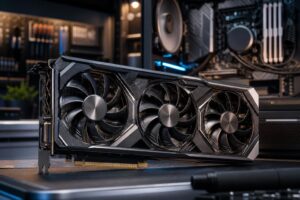
The graphics card remains the biggest performance decision in a custom gaming PC. At 1080p competitive settings, a good midrange GPU can produce excellent results when paired with a fast CPU. At 1440p 240Hz, we generally recommend an upper-midrange or high-end GPU. At 4K, a flagship-class GPU becomes much more reasonable.
GPU features also matter. NVIDIA and AMD cards both support modern upscaling techniques, while ray tracing performance, video encoding needs, display outputs, and the games you play can favor one option over another. If you stream, record gameplay, or use video editing software, check the hardware encoder and software support instead of choosing solely from average FPS charts.
VRAM deserves attention, especially at 1440p and 4K. More VRAM will not make a weak GPU fast, but too little can cause texture compromises, stuttering, or uneven performance in newer games. A 240Hz-focused build should have enough graphics memory for its intended resolution and should not rely on bare-minimum VRAM just to fit a more impressive GPU name into the budget.
These components may not create flashy benchmark headlines, but they are part of what separates a thoughtfully configured custom-built gaming PC from a parts list built around one expensive component.
For a new high-performance gaming system, 32GB of DDR5 memory is the sensible baseline. It leaves room for modern games, browser tabs, Discord, launchers, capture software, and background tasks without constantly running into the limit. Faster memory can help some CPU-bound games, but chasing extreme RAM speeds and loose stability is rarely worth it. A proven, stable kit is the better choice.
Start with at least a 1TB NVMe SSD, but 2TB is more comfortable for most gaming libraries. Large games can consume well over 100GB each, and a nearly full drive is annoying long before it becomes a performance problem. You do not need the most expensive PCIe 5.0 drive strictly for gaming; a quality PCIe 4.0 NVMe SSD still provides excellent load times and better value in many builds.
High sustained frame rates mean sustained heat. A properly sized air cooler or liquid cooler, a case with unrestricted intake, and sensible fan placement help the CPU maintain boost speeds without turning the room into a wind tunnel. Good cooling is also about noise. A quieter PC is easier to live with, particularly when the system is sitting on a desk a few feet away.
Do not cut corners here. Use a quality power supply with adequate headroom for the GPU, CPU, and short power spikes. It should have the correct native connectors for the graphics card and enough capacity to support a reasonable future upgrade. A premium gaming computer deserves reliable, clean power—not the cheapest box that meets a wattage number.
Exact component pricing changes often, but these budget ranges are useful planning tools before you shop.
Remember to budget for the monitor. A 240Hz display with poor response times or no adaptive-sync support can undermine the experience. The panel quality, motion handling, and input latency matter at least as much as the refresh-rate number on the box.
For most people, the best gaming PC for 240Hz combines a current high-performance gaming CPU, 32GB of stable DDR5 memory, a quality 2TB NVMe SSD, an upper-midrange or high-end GPU matched to 1440p, and a well-ventilated case with dependable power delivery. That is the configuration that delivers fast, consistent gameplay without spending heavily on specifications that do not improve the experience.
If your priority is esports at 1080p, move more of the budget toward the CPU and a responsive monitor. If you want 1440p or 4K with high settings and ray tracing, put more toward the GPU and set realistic expectations for the most demanding games.
Overclock Computers can help you turn your game list, monitor choice, and budget into a properly balanced custom gaming PC. Reach out with the games you play and the display you plan to use, and we can recommend a configuration that makes sense without padding the build with parts you do not need.