ECC Memory Explained: Do You Need It in a Professional Workstation?

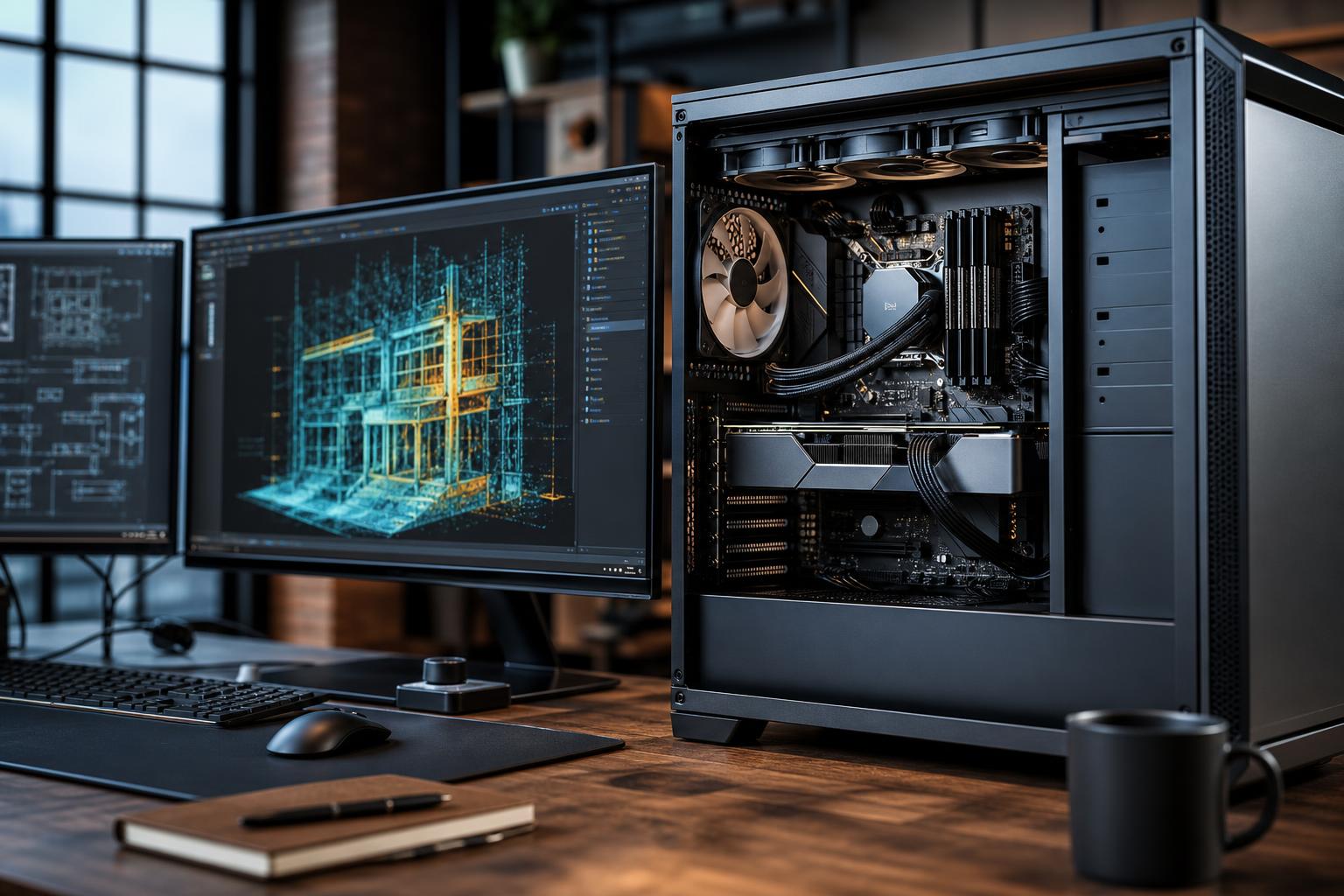
ECC memory is one of those workstation features that sounds either essential or completely unnecessary, depending on who is talking about it. The truth is more practical: ECC RAM is valuable when a memory error could cost you meaningful time, corrupt important work, or undermine confidence in a result. For a typical gaming PC, it usually isn’t a priority. For some professional systems, it is a sensible layer of insurance.
Before spending extra money on ECC memory, understand what it protects, what it does not protect, and what your CPU and motherboard must support. RAM compatibility is not a place for hopeful guessing.
ECC stands for Error-Correcting Code. Standard desktop RAM stores data bits and sends them back when the CPU asks for them. ECC RAM includes additional information that lets the system detect and correct certain errors that occur while data is held in memory.
The most common form used in workstations is called single-error correction, double-error detection, often shortened to SEC-DED. In plain English, it can usually correct a one-bit error and detect, though not correct, many two-bit errors. A bit is a tiny unit of data. One incorrect bit in an image, model, calculation, or file may not always cause visible trouble, but it can. The risk grows as a system has more memory, runs longer jobs, and handles more data.
Memory errors can come from electrical noise, component aging, heat, unstable memory settings, or, more rarely, outside interference. They are not an everyday disaster for most users. Still, a workstation may run simulations, compile large projects, render overnight, process point clouds, or host virtual machines for hours or days. In those cases, catching a bad bit before it becomes bad data is useful.
This is the source of plenty of confusion. DDR5 memory chips commonly include a form of internal error correction known as on-die ECC. It helps the memory chip operate reliably at higher densities and speeds. It does not mean a standard DDR5 desktop kit provides end-to-end ECC protection for the data your computer uses.
For system-level ECC, you need all three of these pieces:
If any one of those is missing, the system may not boot, may run without ECC enabled, or may simply be an unsupported combination. Product pages and manuals matter here. “ECC compatible” can mean different things, including that a board accepts ECC modules but does not actually enable error correction.
ECC is a strong choice for engineers, architects, 3D artists, video professionals, scientific and technical users, developers running virtual machines, and businesses with systems that stay busy for long periods. It is especially reasonable when a crash or silent data error means rerunning an all-night task, troubleshooting questionable output, or delaying a project.
Examples include:
ECC is also sensible for a workstation with 128GB, 256GB, or more memory. More installed RAM means more data is being held in memory at any moment. That does not guarantee an error, but it makes the added protection easier to justify.
ECC often goes hand in hand with workstation-class platforms that support very large memory capacities and more memory channels. If your work genuinely needs hundreds of gigabytes of RAM, the platform decision is usually bigger than ECC alone. A workstation CPU and motherboard may provide the memory capacity, PCIe expansion, and validation that a consumer desktop platform cannot.
Most gaming PCs are better served by putting the ECC budget toward the graphics card, CPU, SSD capacity, monitor, or a well-designed cooling setup. Those upgrades are more likely to improve the experience you notice every day.
ECC also is not mandatory for ordinary office work, web use, schoolwork, or a general-purpose home desktop. Modern non-ECC RAM from reputable manufacturers is reliable, and a properly built PC with sensible memory settings is not inherently fragile.
For a creator who edits occasional videos or a developer working on modest local projects, standard DDR5 is often the reasonable choice as well. Backups, a quality SSD, stable cooling, and avoiding overly aggressive memory overclocks will do more for real-world peace of mind than buying an ECC platform you do not otherwise need.
ECC is excellent at addressing a specific class of memory errors. It is not a cure-all. It cannot protect a file from accidental deletion, a failed SSD, ransomware, a power outage, an application bug, or a bad GPU calculation. It also cannot make an unstable overclock trustworthy.
A dependable workstation still needs a sensible foundation:
We would take a stable, well-cooled non-ECC workstation with a good backup plan over an ECC system built around questionable parts and unchecked settings every time.
Not all ECC memory is interchangeable. Two terms appear often:
RDIMMs generally do not work in motherboards designed for UDIMMs, and standard consumer desktop boards typically do not accept either type. Do not buy RAM based only on the words “DDR5 ECC.” Match the exact module type, capacity, rank configuration where relevant, and speed to the motherboard’s qualified memory information and CPU support.
Also, do not assume an ECC-capable CPU automatically makes every motherboard an ECC motherboard. Platform support is a chain, not a single checkbox.
In a properly configured system, the practical performance difference between comparable ECC and non-ECC memory is usually small. The larger issue is that ECC-capable platforms may offer fewer choices at the extreme end of consumer-focused memory tuning. If your goal is chasing the highest possible memory frequency for competitive gaming benchmarks, ECC is not the usual route.
For professional work, stable capacity matters more than bragging rights. A workstation with enough RAM to keep a large scene, dataset, or group of virtual machines in memory will feel far better than a faster-looking system that runs out of capacity and falls back to storage.
Choose ECC memory for a professional workstation when your work is expensive to repeat, your system runs sustained jobs, you need large memory capacity, or the PC supports a business where reliability has real value. It is particularly worthwhile when you are already selecting a workstation-class platform for its expansion and memory capabilities.
Choose standard DDR5 for gaming, normal creative work, and most enthusiast desktops. Spend the difference where it has a clearer effect: the GPU for gaming and GPU-accelerated creation, additional RAM capacity when you genuinely need it, fast and ample storage, or a better display.
The best computer is not the one with every enterprise feature. It is the one whose parts match the work it must do, with enough reliability margin that you can focus on the job rather than the hardware. If you are unsure whether ECC belongs in your next workstation, contact Overclock Computers with the applications you use, the size of your projects, and your expected memory needs. We can help configure a stable system that makes sense for the work in front of you.