Best Workstation Specs for Point Cloud Processing in 2026

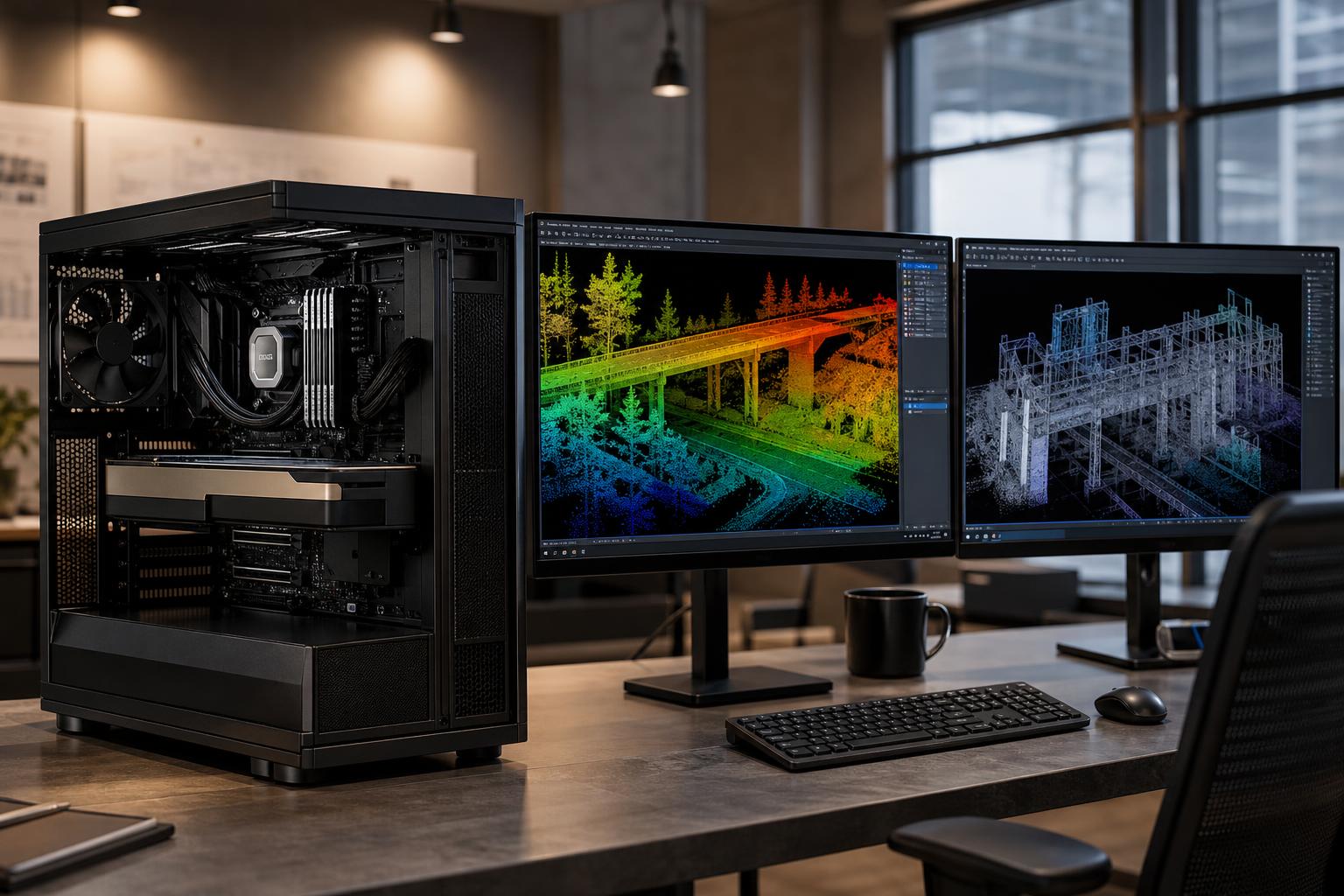
Point-cloud work has a way of exposing weak computers quickly. A system that seems perfectly fast for office work or ordinary CAD can become frustrating when it is loading dense LiDAR scans, registering terrestrial captures, classifying a large corridor, or displaying billions of points alongside CAD and GIS data.
The right point-cloud workstation is not simply the one with the most expensive CPU or graphics card. It needs enough memory to keep active data out of the page file, fast local storage for large files and cache activity, a GPU with sufficient VRAM for visualization, and cooling that can sustain long processing jobs without turning the office into a server closet.
For most professional buyers, the starting point is the software, the size of a typical project, and the part of the workflow that is currently wasting time. A survey firm processing drone LiDAR has different priorities from a scan-to-BIM team registering terrestrial scans or a GIS department serving large datasets across a network.
A point cloud is a collection of measured 3D coordinates, often with color, intensity, classification, timestamps, or other attributes. Modern terrestrial scanners, mobile mapping systems, and LiDAR-equipped drones can create very large files quickly. The original data may also be joined by derived products: registered scans, cleaned clouds, meshes, orthomosaics, CAD drawings, GIS layers, and exports for clients.
Different stages use hardware differently:
That is why a “best PC for point cloud processing” recommendation needs more than a CPU model and a large number on a GPU box. The workstation must be designed around the actual workflow.
Ask what a normal project looks like after import and what the largest project looks like when deadlines are tight. Raw scan count alone is not enough. File formats, point density, attached imagery, derived files, concurrent applications, and the software’s cache behavior all affect the required hardware.
A practical buying question is: Can the workstation hold the active project, the application, the operating system, and reasonable multitasking in memory without relying heavily on disk? If the answer is no, an otherwise powerful PC will feel inconsistent. It may load eventually, but panning, filtering, switching applications, and opening the next file become slow and disruptive.
For professional point-cloud work, 64GB is usually the sensible entry point. It is enough for smaller projects, field-office workflows, moderate scan sets, and general CAD or GIS work. It is not a comfortable long-term target for teams routinely handling large terrestrial scans, mobile mapping, or corridor-scale LiDAR.
Choose 64GB when projects are modest, only one demanding application is normally open, and the workstation is primarily used for viewing, extracting measurements, or light cleanup. It can also fit a user who processes large data only occasionally and can split projects into manageable sections.
For many survey, reality-capture, scan-to-CAD, and GIS users, 128GB is the best starting point. It gives the system room for substantial datasets, a point-cloud application, CAD or GIS software, browsers, and supporting tools without constantly pushing against memory limits. If large files are part of ordinary weekly work rather than an exception, we would generally choose 128GB over spending the same budget on a slightly faster CPU.
256GB becomes reasonable when individual projects are very large, multiple dense datasets must stay active, or processing tasks regularly consume most available memory. It is also appropriate for users combining point clouds with extensive imagery, meshes, GIS data, virtual machines, or other memory-intensive work.
More RAM does not automatically make every operation faster. It prevents slowdowns caused by insufficient memory. For a workstation that is regularly exhausting 64GB, moving to 128GB can be more meaningful than upgrading from an already fast GPU to a faster one.
Point-cloud applications vary widely. Some operations favor fast individual CPU cores; others scale well across many cores. Many real workflows include both. A strong mainstream desktop CPU is often excellent for a user who spends much of the day navigating data, working in CAD, and running lightly threaded tools. A high-core-count workstation processor becomes worthwhile when batch processing, registration, classification, conversion, or simultaneous jobs consume significant working hours.
A modern high-clock-speed CPU with roughly 8 to 16 capable cores is often the right choice for small and medium projects. It offers strong responsiveness in everyday applications while still providing useful multi-threaded processing performance. This is usually the best value for technicians, drafters, and project managers who need a powerful all-round workstation rather than a dedicated processing node.
A Threadripper-class or similar workstation platform earns its cost when the workload needs more than raw core count. These platforms can provide substantially more PCIe connectivity and support for larger memory configurations, additional high-speed storage, specialized expansion cards, and sometimes multiple GPUs.
They make sense for large LiDAR and mobile-mapping projects, frequent batch jobs, users who run several demanding programs at once, and firms that need a machine with a clear upgrade path. They are not automatically better for a user whose main complaint is sluggish 3D navigation; in that case, memory, GPU VRAM, or storage may be the real issue.
A good GPU helps keep dense clouds responsive while orbiting, clipping, coloring, and viewing complex 3D scenes. The amount of VRAM matters because it determines how much graphics data can stay close to the GPU. When a scene exceeds available VRAM, performance can become uneven even if the GPU itself is powerful.
For professional point-cloud visualization, a GPU with 12GB to 16GB of VRAM is a practical baseline for serious work. For large projects, high-resolution displays, demanding visualization, GPU-accelerated processing, or workflows that combine clouds with textured models, 20GB to 32GB or more can be justified.
The right choice between a professional GPU and a consumer GPU depends on the application, required VRAM, driver requirements, display outputs, reliability expectations, and budget. A consumer GPU can provide excellent value for applications that benefit from its compute performance and do not require a particular professional driver ecosystem. A professional GPU may be the better fit when large VRAM capacity, application-specific driver considerations, or specialized workflow requirements justify its higher cost. Neither category is universally superior.
Fast storage will not compensate for inadequate RAM, but it has a major effect on imports, caching, file copying, saving, and general workflow responsiveness. One large drive is workable, but a multi-drive layout is usually more practical for a professional point-cloud workstation.
Keep active projects on local NVMe storage whenever practical. Working directly from a busy network share can limit load and save performance, especially when several staff members access large files. For teams moving large datasets to and from central storage, 10GbE networking may be a worthwhile workstation option. It does not replace local SSD capacity, but it can make collaboration and data transfer far less painful.
This tier suits individual survey professionals, CAD technicians, and GIS users working with moderate datasets. It is responsive, capable, and avoids wasting budget on hardware that the workload may not use.
This is the most balanced configuration for firms processing large scan sets routinely, producing deliverables under deadline, and keeping CAD, GIS, and point-cloud tools open together.
This tier is for mobile mapping, major infrastructure projects, very dense terrestrial scan work, dedicated processing roles, and organizations that need room for future storage, memory, and PCIe expansion.
Point-cloud processing can keep a CPU and GPU busy for hours. A workstation needs an appropriately sized cooler, sensible case airflow, and a quality power supply so performance remains stable under sustained load. Quiet cooling also matters in offices where the system is running next to the person using it all day.
For business buyers, internal layout and component selection affect serviceability as well. Standard, well-supported parts and a sensible storage layout make future memory additions, drive replacements, and GPU upgrades much easier than a tightly constrained prebuilt design.
If your current workstation runs out of memory, buy more memory. If visualization stalls with dense data, investigate GPU performance and VRAM. If registration and classification jobs occupy a machine for too long, invest in more CPU throughput. If large projects take too long to open, copy, and save, improve the active-project storage and network path.
Overclock Computers builds custom point-cloud workstations around the software you use, your typical and largest project sizes, the data you keep local, and the upgrades you expect to make later. Contact our team with your applications and a representative description of your workflow, and we can help specify a workstation that improves the work that actually occupies your day.